Showing posts with label AMIEon blogspot. Show all posts

Thursday, January 27, 2011

Mechanical Properties of Materials

Hello Everyone,
  Well I am a little tensed. Exam dates have been released. My preparation till now amounts to almost nothing and the pressure is huge. So started serious study from today morning itself.


  So stated with chapter called as Mechanical Properties of Materials. So the important topics to be studied here include:
Well I stated at-last. Will see what is gonna happen at the D-Day


with warm regards
AllMyPosts

Monday, December 27, 2010

Eutectic Systems

       A eutectic system is a mixture of chemical compounds or elements that has a single chemical composition that solidifies at a lower temperature than any other composition. This composition is known as the eutectic composition and the temperature is known as the eutectic temperature. On a phase diagram the intersection of the eutectic temperature and the eutectic composition gives the eutectic point. Not all binary alloys have a eutectic point; for example, in the silver-gold system the melt temperature (liquidus) and freeze temperature (solidus) both increase monotonically as the mix changes from pure silver to pure gold.


The eutectic reaction is defined as follows:
\text{Liquid} \xrightarrow[\text{cooling}]{\text{eutectic temperature}} \alpha \,\, \text{solid solution} + \beta \,\, \text{solid solution}
        This type of reaction is an invariant reaction, because it is in thermal equilibrium; another way to define this is the Gibbs free energy equals zero. Tangibly, this means the liquid and two solid solutions all coexist at the same time and are in chemical equilibrium. There is also a thermal arrest for the duration of the reaction.

        The resulting solid macrostructure from a eutectic reaction depends on a few factors. The most important factor is how the two solid solutions nucleate and grow. The most common structure is a lamellar structure, but other possible structures include rodlike, globular, and acicula


         The above info is taken from Wikipedia. Please do refer to them for further info.


with warm regards
allmyposts

Monday, December 20, 2010

Presentation on Binary Isomorphous System

I was surfing the web for some good presentation on Binary Isomorhous Systems. I found one here. I am embedding the same here:


with warm regards
almyposts

Eutectic reaction

Eutectic reaction:

A three-phase reaction in which, upon cooling, a liquid transforms to give two solid phases. 

e.g:                                 L ® α + b


The above information is taken from here

Tie Line

Tie Line:
An imaginary horizontal line (isotherm) spanning a two-phase region of an equilibrium phase diagram, terminating at the nearest phase boundaries on either side.

 Tie lines are important when using phase diagrams to predict the constitution of two-phase materials.

The above information is taken from here

Friday, December 17, 2010

Old Questions, Material Science, Chap 3

      I understand that AMIE is tough and its not enough to just read the study material. So I decided to scan through the old question papers. As of now I am studying the second chapter ( phase diagrams ). So I segregated the questions in this chapter for the benefit of all. Please do go through them and decide on what all topics to be studied for the exams.


with warm regards
Abhishek Boinapalli

Thursday, December 2, 2010

Phase diagrams & Lever Rule

Hello Everyone,


     This blog is about my preparation to crack section A of AMIE in single go. As of now, I am studying Material Science & Engineering and I post notes, question papers, solved problems, tips info & such here.


    I found a very very cool ppt on Phase Diagrams, Gibbs Rule & Solubility stuff, alloy steels and lever rules. It is shown below:


The above pdf is taken from http://www.ce.berkeley.edu/~paulmont/CE60New/alloys_steel.pdf.

Wednesday, December 1, 2010

Triple Points & Gibbs Rule

Hello Everyone,

    I intend to write small note on triple point which I came across while studying for Phase Diagrams chapter of Material Science in section A of AMIE.

    In thermodynamics, the triple point of a substance is the temperature and pressure at which three phases (for example, gas, liquid, and solid) of that substance coexist in thermodynamic equilibrium. For example, the triple point of mercury occurs at a temperature of −38.8344 °C and a pressure of 0.2 mPa.
In addition to the triple point between solid, liquid, and gas, there can be triple points involving more than one solid phase, for substances with multiple polymorphs. Helium-4 is a special case that presents a triple point involving two different fluid phases (see lambda point). In general, for a system with p possible phases, there are {p\choose 3} = 
\tfrac16p(p-1)(p-2) triple points.


        The triple point of water is used to define the kelvin, the SI base unit of thermodynamic temperature. The number given for the temperature of the triple point of water is an exact definition rather than a measured quantity. The triple points of several substances are used to define points in the ITS-90 international temperature scale, ranging from the triple point of hydrogen (13.8033 K) to the triple point of water (273.16 K).

The above information is taken from Wikipedia. Please do refer to them for more info.

Basics of Phase diagrams

      Phase diagrams are one of the most important sources of information concerning the behavior of elements, compounds and solutions. They provide us with the knowledge of phase composition and phase stability as a function of temperature (T), pressure (P) and composition (C). Furthermore, they permit us to study and control important processes such as phase separation, solidification, sintering, purification, growth and doping of single crystals for technological and other applications. Although phase diagrams provide information about systems at equilibrium, they can also assist in predicting phase relations, compositional changes and structures in systems not at equilibrium.

     The phase rule, also known as the Gibbs phase rule, relates the number of components and the number of degrees of freedom in a system at equilibrium by the formula
                                       F = C – P + 2
where F equals the number of degrees of freedom or the number of independent variables, C equals the number of components in a system in equilibrium and P equals the number of phases. The digit 2 stands for the two variables, temperature and pressure.


    The number of degrees of freedom (F) of a system is the number of variables that may be changed independently without causing the appearance of a new phase or disappearance of an existing phase.

    Please note that the value of F cannot be less than 0. So the maximum number of phases can be found out using the Gibbs Formula with taking thermodynamics into consideration.

    The point at which F = 0 , is called invariant point. The point at which the three phases can co-exist is called triple point


with warm regards
AllmMyPosts


Some of the info on this post has been taken from the url: http://web.mit.edu/3.091/www/archives/Notes_10.pdf. Please do refer to the same for more info.

Monday, November 29, 2010

Syllabus Material Science, AMIE

MATERIAL SCIENCE AND ENGINEERING (AD 302)
Group A
Introduction to materials:
Metal and alloys, ceramics, polymers and semiconducting materials—introduction and application as engineering materials.

Defects in solids:
Point, line and surface defects. Diffusion in solids.

Phase diagrams: Monocomponent and binary systems, non-equilibrium system, phase diagram and application in crystalline and non-crystalline solids.

Mechanical properties: Tensile strength, yield strength, elastic and viscoelastic properties, creep, stress relaxation and impact. Fracture behaviour. Ductile fracture, Griffith theory, effect of heat treatment and temperature on properties of metals.

Deformation of metals: Elastic and plastic deformation, slip, twin, dislocation theory, critical resolved shear stress, deformation in polycrystalline materials, season cracking, Bachinger's effect, strengthing mechanics, work hardening recovery, crystallisation and grain growth, cold and hot working.

Group B


Heat treatment:
Iron-carbon system. Annealing, normalising, hardening, critical cooling rate, hardenability, age hardening, surface hardening, tempering.

Thermal properties: High temperature materials, materials for cryogenic application, thermally insulating materials. (Specific heat, thermal conductivity, thermal expansion).

Ceramic materials and polymers:
Silicon structures, polymerism fraction in glass, electrical properties of ceramic phases, rocks, building stones, refractories.

Polymerisation mechanism:
structural properties of polymer, thermoplastics, thermosets, elastomer, resins, composites, particle and fibre reinforced composite. Composite material including nano material.

Electronic properties:
Magnetism, dimagnetism, paramagnetism, ferromagnetism, magnetic energy, zone theory of solids, zones in conductors and insulators.

Recommended Books  
      □ L A Vanblack. Elements of Material Science and Engineering. Addison-Wesley (Indian edition).  
      □ V Raghavan. Material Science and Engineering. Prentice-Hall of India (P) Ltd, New Delhi.


The above syllabus is taken from "http://trimurtuluamie.wetpaint.com/page/AMIE+-+SECTION++A++SYLLABUS". Please do refer to the same for further details

Chapter 03, Phase Diagrams

Hello Everyone,


     After a week or so spent lethargically, I am back to study. So I intend to study about "Phase diagrams". I was going through the Syllabus the other day and felt that this chapter is cool. What do we need to cover in this chapter??? As per me the following are must, please do let me know if I am missing something here
  • Phases & micro-structure's basic concepts 
  • Solubility and limitations
  • Mono-component and binary systems
  • Non-equilibrium system
  • Phase diagram and. application in crystalline and non-crystalline solids.
  •  Lever rule and applications
  • Effects of phases on Mechanical properties 


    Hello Everyone again, After starting the real study ( i.e. the books and such ) the above given points are not ample as per me. So I am updating a list of topics that should be studied for clearing all questions which may arise from this topic:
  • Introduction to phases, phase diagrams & need for studying the same
  • Mono-component systems, Gibbs phase rule & applications
  • Binary phase diagrams, triple points, invariant points
  • Isomorphic systems, applications of phase diagrams (lever rule)
  • Non - equilibrium solidification of alloys, problems related to cooling
  • Alloy Systems (Binary Eutectoid, Hypo-Eutectoid plain carbon steels, Hyper-Eutectiod plain carbon steels )
  • Non - crystalline solids and phases in them
with warm regards
AllMyPosts

Thursday, November 25, 2010

What is the best way to head with Material Science??

Hello Everyone,


    To those who are new, this is a blog to blog about my preparation & plans to crack the hell out of section A of AMIE. I started with the subject MATERIAL SCIENCE AND ENGINEERING. 

    This subject is little tough for the simple reason that I am into computer science after my high school and am not at all interested in this topic. So its little difficult for me to choose the right topic & to keep me interested. I am done with two chapters viz Introduction to Material Science & Introduction to point defects. 

    So please do suggest me some good study plan. Should I just go forward and complete the topics in syllabus in lexical order / order given in syllabus or should I choose some good chapter? If later, what are the good chapters in the syllabus?


    Please do enlighten me on the same.

with warm regards
allmyposts

What is the most fetching topic in Material Science??

Hello Everyone,


    I was wondering about what is the most fetching topic in Material Science. I was going through the old question papers sometime back. I find a pattern when it comes to questions from some chapters like burgers vector, APF of crystal,... I also find that the pattern is not very strong in itself.


    So tell me which topic / chapter is really fetching in material Science of section A of AMIE exams?

Monday, November 22, 2010

Cool PPT on Crystal Defects

I have found a cool ppt on Crystal Defects. Please do go through the same.


Please note, the ppt is not mine. I found it floating on the web and don't claim any copyright of the same. I am sorry that I couldn't post the source as I forgot the same.


No. Of Atoms in Zinc Unit Cell

I have been going through the question papers again. I found a rather interesting question viz "Calculate the no. of atoms in zinc unit cell?"


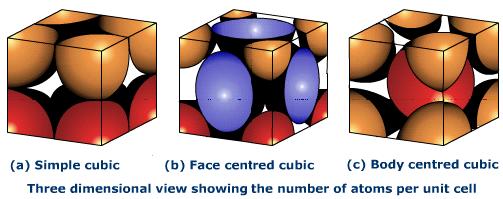
First some basics about Calculation of Number of Particles per Unit Cell of a Cubic Crystal System.
Keeping the following points in mind we can calculate the number of atoms in a unit cell.
  • An atom at the corner is shared by eight unit cells. Hence an atom at the corner contributes 1/8 to the unit cell
  • An atom at the face is a shared by two unit cells
Contribution of each atom on the face is 1/2 to the unit cell.
  • An atom within the body of the unit cell is shared by no other unit cell
Contribution of each atom within the body is 1 to the unit cell.
  • An atom present on the edge is shared by four unit cells
Contribution of each atom on the edge is 1/4 to the unit cell.
By applying these rules, we can calculate the number of atoms in the different cubic unit cells of monoatomic substances.


(The above concepts are taken from tutorvista.com. Please refer to them from more info)

Now I intend to answer this question in this post as I find it little cool. Zinc is having HCP structure as per Material Science and Engineering by Raghavan. A cool image showing the HCP structure is here:

    It is clear from the image that 3 atoms are inside the body of the HCP unit structure. So the count of atoms is 3 as of now.  

    It is clear from the image that the hexagonal faces have one atom each. But each such atom is shared by two HCP units equally. Hence the count of atoms comes to "4" here.

   Now, the atoms at the twelve points ( hexagonal edges on top and bottom ) make another two atoms. Hence count is 6 totally. 


    A simple explaination of the same given at answers.com is given below. Please do refer to the same.


    There are 6 atoms in the hcp unit cell. The hex shape has six atoms at the points that are direct translations of each other making 1 atom for the top hex and one atom for the bottom hex. That's 2. The atom in the center of the top and center of the bottom are translations giving 1 more. That's 3. Then there are 3 atoms in the middle region of each cell bringing the total to 6


Friday, November 19, 2010

Old Questions. Material Science. Chap. 02.

    I understand that AMIE is tough and its not enough to just read the study material. So I decided to scan through the old question papers. As of now I am studying the second chapter ( defects in crystals ). So I segregated the questions in this chapter for the benefit of all. Please do go through them and decide on what all topics to be studied for the exams.


with warm regards
Abhishek Boinapalli

Thursday, November 18, 2010

Atomic Packing Factor

         In crystallography, atomic packing factor (APF) or packing fraction is the fraction of volume in a crystal structure that is occupied by atoms. It is dimensionless and always less than unity. For practical purposes, the APF of a crystal structure is determined by assuming that atoms are rigid spheres. The radius of the spheres is taken to be the maximal value such that the atoms do not overlap. For one-component crystals (those that contain only one type of atom), the APF is represented mathematically by
\mathrm{APF} = \frac{N_\mathrm{atoms} V_\mathrm{atom}}{V_\mathrm{unit cell}}
where Natoms is the number of atoms in the unit cell, Vatom is the volume of an atom, and Vunit cell is the volume occupied by the unit cell. It can be proven mathematically that for one-component structures, the most dense arrangement of atoms has an APF of about 0.74. In reality, this number can be higher due to specific intermolecular factors. For multiple-component structures, the APF can exceed 0.74.


Worked out example

Body-centered cubic crystal structure


BCC structure
       The primitive unit cell for the body-centered cubic (BCC) crystal structure contains nine atoms: one on each corner of the cube and one atom in the center. Because the volume of each corner atom is shared between adjacent cells, each BCC cell contains two atoms.
Each corner atom touches the center atom. A line that is drawn from one corner of the cube through the center and to the other corner passes through 4r, where r is the radius of an atom. By geometry, the length of the diagonal is a√3. Therefore, the length of each side of the BCC structure can be related to the radius of the atom by
a = \frac{4r}{\sqrt{3}}.
     Knowing this and the formula for the volume of a sphere((4 / 3)pi r3), it becomes possible to calculate the APF as follows:
\mathrm{APF} = \frac{N_\mathrm{atoms} V_\mathrm{atom}}{V_\mathrm{crystal}} = \frac{2 (4/3)\pi r^3}{(4r/\sqrt{3})^3}

= \frac{\pi\sqrt{3}}{8} \approx 0.68.\,\!  The above information is taken from Wikipedia. Please do refer to the same for further info.
 with warm regards
allmyposts

Wednesday, November 17, 2010

Diffusion In Solids

I was studying about diffusion in solids. The simplest definition of diffusion is "movement of atoms in solids under thermal energy and a gradient" is called diffusion. Where the gradient can be concentration or Electric / Magnetic field ...


This is relatively simple topic and can be easily understood. But the topic is a little important as questions regarding time taken for carburization are repeatedly asked in the question papers.


The important topics to study include:
  • Diffusion mechanisms (vacency, interstitial ..)
  • Rate of diffusion in steady state and non steady state (Ficks first law and second law)
  • Kirkendall effect

Perfect resource for this topic is study material by IEI. But the book by Raghavan is also very very good. The book is available here

Don't forget to grab a copy of Material Science and Engineering book, which is essential for preparing for AMIE, Material Science.
with warm regards
allmyposts

Monday, November 15, 2010

Line defects and Surface defects

    Yeah, I was reading about these topics only from last Saturday. Please head to my advice, this is the wrong way of spending your weekend. So basically there is a lot to study, but everything is quite easy to understand. Video tutorials can be of great help in this issue, but alas, I couldn't surf for the same till now. I shall update the same here at the earliest.


What all needs to be covered:
  1. What are line defects, what are dislocations? ( both are same basically )
  2. Types of line defects viz screw dislocation & edge dislocation.
  3. How to find out the burgers vector for a given defect. What is burgers circuit, how to find out the direction of burgers vector. What is Burgers Vector?
  4. What are various types of surface defects? 
  5. Study about grain boundary and interface, tilt boundary, twinning, stacking faults & such.

Note:
  • Twinning is important concept as the same is asked many many times in the old question papers.
  • For simple definitions of defects and classification please refer to material science by RS Khurmi & RS Sedha 
  • For brief and clear cut explanation please refer to the  study material provided by AMIE


Resources:
  • A good pdf which helps to visualize the dislocations is here
  • A good image to help visualize point defects is here
  • Another point defect explanation here

Don't forget to grab a copy of Material Science and Engineering book, which is essential for preparing for AMIE, Material Science.


with warm regards
allmyposts

Friday, November 12, 2010

Point Defects in Crystals

One more hard day of studying. So I was going through point defects in crystals. Before reading about point defects please understand what crystals are and why you need to study their internal structures and how defects effect the structure sensitive properties of the material


This stuff is really interesting in itself. You gotta study a lot from vacancy, interstitial defects, constitutional impurity, Schotty defect, Frenkel defect and all such. 


Also study what enthalpy of formation is? How to calculate the same? The effects of defects on the bonds between atoms, on the stress and strain and elasticity ....


The material science & Engineer by Raghavan &  Material Science by RS Khurmi & RS Sedha are good books for the same. I am following the later

The basics of point defects in crystals can be summarzied as follows:
  • Vacancy – missing atom at a certain crystal lattice position; 
  • Interstitial impurity atom – extra impurity atom in an interstitial position
  • Self-interstitial atom – extra atom in an interstitial position; 
  • Substitution impurity atom – impurity atom, substituting an atom in crystal lattice; 
  •  Frenkel defect – extra self-interstitial atom, responsible for the vacancy nearby.

The above summary is taken from www.substech.com. Please refer to them for further info. 


A lot more stuff has to be studied regarding effects of defects in the crystal, the calculation of equilibrium concentration of vacancies, drawing miller indices for given plane and for given crystal direction and all such.... Geez will this ever end???


Don't forget to grab a copy of Material Science and Engineering book, which is essential for preparing for AMIE, Material Science.

with warm regards
allmyposts
Related Posts Plugin for WordPress, Blogger...